

The Great Integration Continues
From Goldman to EQT, private markets are no longer an asset class — they are becoming infrastructure.

Five months on, the pattern is no longer subtle.
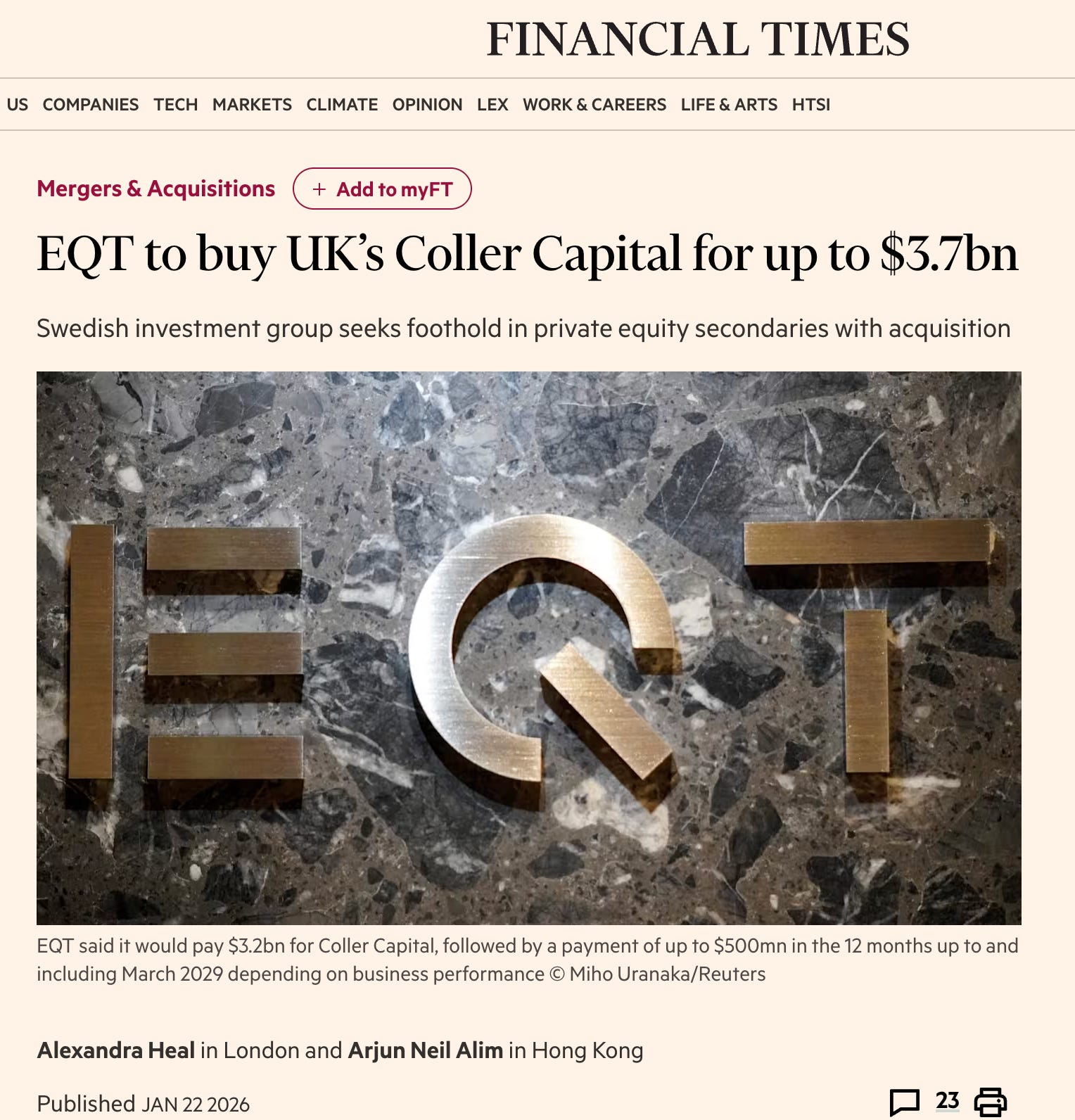
EQT’s acquisition of Coller Capital is not just another large secondaries deal. It is confirmation that the centre of gravity in private markets has decisively shifted.
Goldman bought Industry Ventures.
Morgan Stanley bought EquityZen.
Apollo partnered with 8VC.
Schwab bought Forge.
Now EQT buys Coller.
Different institutions. Same direction.
What unites all these moves is not asset gathering. It is control of liquidity in a world where exits no longer clear.
Coller matters here because it represents the mature end of the secondaries spectrum: LP stakes, GP-leds, continuation vehicles, credit secondaries, and NAV financing. In other words, the machinery that keeps private capital moving when primary exits stall.
EQT is not buying Coller to become “better at secondaries”.
It is buying Coller to rebuild its growth engine around recycling rather than exits.
That is the real shift.
For twenty years, private equity growth depended on selling companies.
Today, it increasingly depends on selling time.
Secondaries, GP-leds, credit against portfolios, evergreen vehicles for wealthy individuals — these are all expressions of the same idea: capital must circulate even when assets do not exist.
Two things are worth underlining now, with hindsight:
First, scale is no longer optional.
Per Franzén is explicit: scale increasingly matters. That is not marketing language. It reflects the reality that liquidity solutions only work if balance sheets, data, and distribution sit under one roof. EQT buying Coller is Europe’s answer to Goldman–Industry Ventures.
Second, private markets are being redesigned for individuals, not just institutions.
Evergreen funds, open-ended vehicles, credit secondaries, retail-access products — the Coller EQT arm aimed at wealthy investors is not an add-on. It is the destination. The same logic that drove Schwab to buy Forge is now visible in European private capital.
Zooming out, this points to something broader that is now hard to ignore.
Private markets are no longer an asset class.
They are becoming infrastructure.
Liquidity, credit, duration, and access — these used to be outcomes of markets. They are now engineered features of platforms. The institutions that won today are not the best stock pickers. They are the ones who own the rails.
Five months ago, this looked like a coincidence.
Today, with EQT–Coller, it looks like the operating system is being finalised.
The great integration is not slowing down.
It is consolidating.
Read more about The Great Integration here.
Private markets are clearly evolving from standalone asset classes into integrated infrastructure, where control of liquidity and scale defines the winners